|

| |
 |
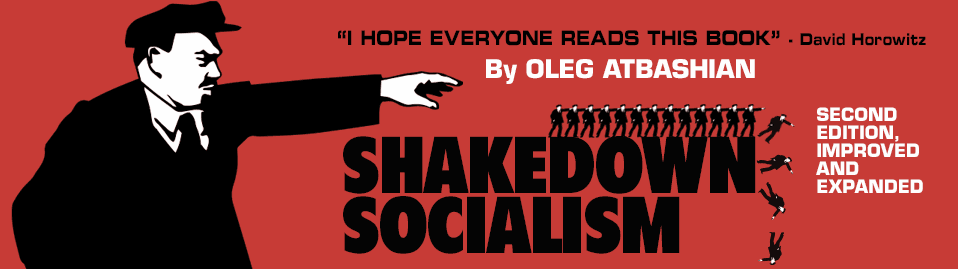
David Horowitz: "Oleg Atbashian has written a timely warning for Americans about the collectivists among us and their plans for the future. I hope everyone reads this book."
David Horowitz is the Author of Uncivil Wars (2003); The Professors: the 101 Most Dangerous Academics in
America (2006); Indoctrination U. (2008); One Party Classroom (2009)
|
|
| |
|
|
|
| |
 |
Robert Spencer: "Brightly written and filled with entertaining and illuminating illustrations, Oleg Atbashian's Shakedown Socialism is a clear and eye-opening guide to exactly what is wrong with socialism and state control of the means of production, and how it kills both the economy and human initiative. Atbashian saw it all up close in the Soviet Union, and now he sees Barack Obama making the same mistakes - and sounds this clarion call for economic sanity, before it's too late. Shakedown Socialism is an essential and inspiring guide to the virtues of the free market."
Robert Spencer is the author of the New York Times bestsellers The Politically Incorrect Guide to Islam (and the Crusades) and The Truth About Muhammad
|
|
| |
|
|
|
| |
 |
Pamela Geller: "Ayn Rand saw it coming: 'When government controls are introduced into a free economy, they create economic dislocations, hardships and problems, which - if the controls are not repealed - necessitate further controls, which necessitate still further controls, etc.' In his brilliant, witty, and wonderfully illustrated Shakedown Socialism, Oleg Atbashian - who grew up in the Soviet Union, shows how that process is happening in Obama's America today, and explains why that is putting us on the road to ruin. Shakedown Socialism is an enlightening, sobering, and wonderfully clear explanation of why statism kills - and thus also of why and how Barack Obama is killing the American economy. Oleg quotes Putin saying that when the Soviets made the state's role absolute, the U.S.S.R. became completely economically uncompetitive, and no one wants to see that repeated. No one except Obama, that is. This book shows why Obama's statist economic policies are a looming disaster for America and for the spirit of the free human individual."
Pamela Geller is the author of The Post-American Presidency: The Obama Administration's War On America, as well as a
prominent blogger at Atlas Shrugs
|
|
|
 |

Socialism in the United States?
Novoye Russkoye Slovo | see it at NRS archive | PDF archive (p.22) |

| English translation |
Russian original
|
Socialism in the USA?
By Alexey ORLOV
Novoye Russkoye Slovo, September 24, 2010, Page 22.
Books make the best gifts, so my advice to all parents and grandparents this holiday season: give your child this book, Shakedown Socialism, written by Oleg Atbashian - for that matter, give it under any excuse, be it a national or religious holiday, or just a family occasion.
I highly recommend that all parents and grandparents read this book, too. A word of warning (for the Russian speakers): it is written in English. Most importantly, while many of you already have an intimate knowledge of socialism, our children and grandchildren don't, and you may not always have the right words to explain it to them. Our children are lucky not to live in a country called the Union of Soviet Socialist Republics. Lucky they may be, but they lack our invaluable life experience, and so they readily believe the stories told by their teachers in public schools and universities, about how there can be "no justice" in a world that is divided into the rich and the poor, the exploiters and the exploited. Atbashian's book can help our children to see exactly what wrongheaded ideas lurk behind the effort to institute "economic justice" in the United States. They must know that should such an effort succeed, America will in many ways become similar to the country from which their parents and grandparents had fled.
Shakedown Socialism could only have been penned by someone born and raised in the country of "victorious socialism." Former Soviet citizens are better equipped to recognize the mayhem taking place in the United States today, as they immediately bring back memories of their Soviet past. Having come to America from Ukraine in 1994, writer and artist Oleg Atbashian discovered a country whose political realities increasingly resembled those that plagued the USSR.
Atbashian is a talented political satirist. His Shakedown Socialism describes to the English-speaking readers what living in the U.S. will be like if it follows the path outlined by Barack Hussein Obama and his supporters in Congress.
While Shakedown Socialism is Atbashian's first book, I was already familiar with his work beginning with 2004, when he was running his Communists for Kerry website. It was the year of a heated election campaign, where President George W. Bush was opposed by the Democratic candidate from Massachusetts, Sen. John Kerry, who three decades earlier had slandered America's military, accusing its soldiers and officers of war crimes. Naturally, Kerry was supported by everyone on the left, including the communists.
Atbashian co-founded a street theater group called Communists for Kerry, which performed in New York City parks. Their improvised performances in Union Square attracted not only spectators, but also other volunteers who came dressed up in "communist" costumes. The Communist for Kerry website enjoyed international popularity. T-shirts purchased from them online with the image of "Comrade Kerry" could be seen at rallies in Paris, France. In Australia, their followers performed their own version of Communists for Kerry.
In 2005 Atbashian created a new website, ThePeoplesCube.com, which in today's America is, in my opinion, the best - that's right, the best! - satirical website. Just open it and you will be of the same opinion, too.
We all know what the Rubik's Cube is; there is hardly anyone who hasn't tried to solve that puzzle. But how many of us have succeeded? Life is not fair. We are all different - beautiful and ugly, strong and weak, smart and not so much... There is nothing anyone can do about the fact that some are born with high IQ while others aren't.
Can life be made fairer? Socialists have a ready answer: take from the rich and give to the poor - or, as the Russian Bolsheviks put it, "loot the looters." Democratic countries practice a more civilized form of looting: taxation. But is there a way to help those not smart enough to solve the Rubik's Cube? Atbashian has brilliantly solved this problem by inventing the People's Cube.
Just like the Rubik's Cube, the People's Cube has six sides. But since different colors on each side overcomplicate things, Atbashian has introduced a more equal version - the equivalent of "social justice" for all people of the Earth! All six sides of People's Cube are of one and the same color - red.
ThePeoplesCube.com was launched in 2005. Today it is one of the most popular political websites. I browse it every day, sometimes several times a day. It offered the best, in my opinion, reporting and pictures about the rally against the construction of an Islamic center two blocks away from Ground Zero. But first and foremost The People's Cube is famous for its top-quality political satire. Anyone who reads it will certainly agree with this assessment. But I must warn the admirers of the current occupant of the White House: don't open ThePeoplesCube.com unless you have heart medicine within close reach.
Going back to Shakedown Socialism: "I hope everyone reads this book," wrote David Horowitz, author of many political best-sellers, including One-Party Classroom: How Radical Professors at America's Top Colleges Indoctrinate Students and Undermine Our Democracy.
I completely agree: Shakedown Socialism is a must-read for anyone who is concerned about this country's future. President Obama has read it, too. If you need proof, go to ThePeoplesCube.com and see the picture where Obama gives his favorite book to Venezuela's president Hugo Chavez. That book is, of course, Shakedown Socialism by Oleg Atbashian.
Alexey ORLOV
|
Социализм в США?
Алексей ОРЛОВ
Новое Русское Слово - 24 сентября 2010 - КНИЖНАЯ ПОЛКА - cт.22
Папы и мамы, дедушки и бабушки, памятуя о том, что книга – лучший подарок, я хочу дать вам совет: в ближайший праздник – семейный, религиозный или национальный – подарите своему ребенку или внуку книгу Олега Атбашьяна «Стяжательский социализм»
И вам, папы и мамы, дедушки и бабушки, я очень советую прочитать эту книгу. Но должен предупредить вас, что, во-первых, она на английском языке. Во-вторых (и это, пожалуй, главное), вы, будучи взрослыми, достаточно хорошо осведомлены о социализме, но о нем мало что знают наши дети и внуки. Им повезло не жить в стране, называвшейся Союз Советских Социалистических Республик. Повезло-то им повезло, но они не получили того неоценимого жизненного опыта, который есть у нас, и поэтому они верят учителям в школе и профессорам в университетах, говорящим о царящей в мире «несправедливости» – о богатых и бедных, об эксплуататорах и эксплуатируемых... Книга Атбашьяна поможет нашим детям и внукам понять, что в их стране, Соединенных Штатах Америки, уже предпринимаются усилия, чтобы покончить с «несправедливостью». Но им невдомек, что если с ней будет покончено, Америка во многом уподобится той стране, из которой бежали их папы и мамы, дедушки и бабушки.
Книга Shakedown Socialism («Cтяжательский социализм») могла быть написана только человеком, родившимся, выросшим и сформировавшимся в стране «победившего социализма». Бывшему жителю СССР лучше видны безобразия, происходящие ныне в Соединенных Штатах, поскольку они немедленно воскрешают в памяти то, чему он был свидетелем в своем советском прошлом. Журналист и художник Олег Атбашьян уехал в Америку с Украины в 1994 году и столкнулся в новой стране с политическими реалиями, схожими с теми, какие были в СССР.
Атбашьян – талантливый политический сатирик. В книге «Стяжательский социализм» он рассказывает англоязычному читателю, во что могут в конце концов превратиться США, если будут двигаться курсом, который избрал Барак Хусейн Обама и его единомышленники в Конгрессе.
«Стяжательский социализм» – первая книга Атбашьяна, но я познакомился с его творчеством еще в 2004 году, когда он открыл свой сайт Communists for Kerry. Это было время предвыборной борьбы президента Джорджа Буша с кандидатом Демократической партии массачусетсским сенатором Джоном Керри, который тремя десятилетияими ранее клеветал на американскую армию, обвиняя ее солдат и офицеров в преступлениях. Естественно, что его поддерживали все левые силы страны, в том числе и коммунисты.
Атбашьян организовал театральную группу «Коммунисты за Керри», которая выступала в нью-йоркских парках. На Юнион-сквер импровизированные спектакли привлекали не только зрителей, но и энтузиастов, рядившихся в «коммунистические костюмы». Что же касается вебсайта Communist for Kerry, то он пользовался международной известностью. Купленные на этом сайте футболки с изображением «коммуниста Керри» были замечены на демонстрациях в Париже. В Австралии молодежная труппа тоже выступала со спектаклем «Коммунисты за Керри».
В 2005 году Атбашьян создал новый интернетский сайт thepeoplescube.com, и в сегодняшней Америке это, на мой взгляд, лучший – да, да, лучший! – сайт политической сатиры. В этом может убедиться каждый.
Кто не знает кубика Рубика? Точнее, кто из нас не пытался решить эту головоломку? Полагаю, что таковых нет или почти нет. Но вот многие ли из пытавшихся сумели ее решить? Жизнь несправедлива. В ней есть красивые и уроды, сильные и слабые, умные и не очень... Одни рождаются с высоким IQ, другие с низким, и ничего тут не поделаешь...
Жизнь несправедлива... Как сделать ее справедливой? У социалистов есть ответ: надо отнимать у богатых то, что они заработали, и отдавать бедным. Российские большевики называли это просто: «Грабь награбленное!». В демократических странах существует цивилизованный способ грабежа – налогообложение... Ну, а как несообразительному помочь в решении кубика Рубика? Атбашьян блестяще решил эту проблему – изобрел Народный кубик.
В Народном – как и у Рубика – шесть граней, но у Рубика – у каждой грани свой цвет, и это усложняет задачу. Атбашьян ее упростил, точнее – сделал справедливой (!) для всего населения Земли. В Народном кубике у всех шести граней один цвет – красный.
Thepeoplescube.com был запущен в 2005 году. Сегодня это один из популярнейших политических сайтов. Я «залезаю» в этот сайт ежедневно, несколько раз в день. На этом сайте был помещен лучший, с моей точки зрения, фоторепортаж о демонстрации-протесте против строительства исламского центра в двух кварталах от Граунд Зиро... Но славится «Народный кубик» прежде всего политической сатирой. Ее уровень? Каждый из вас, читатель, легко убедится, насколько он высок. Я, однако, обязан предупредить почитателей нынешнего обитателя Белого дома: перед тем, как открыть сайт thepeoplescube.com, приготовьте себе какое-нибудь сердечное лекарство.
Вернемся, однако, к книге «Стяжательский социализм». «Надеюсь, каждый прочтет эту книгу», – сказал о ней Дэвид Горовитц, автор многих политических бестселлеров, последний из которых – «One Party Classroom» – повествует о засилье левой профессуры в университетах.
Я согласен с ним: книгу «Стяжательский социализм» должен прочесть каждый, кого беспокоит будущее нашей страны. Читал ее и президент Обама. В этом легко убедиться, заглянув на сайт thepeoplescube.com. Здесь вы найдете фотографию: Обама дарит президенту Венесуэлы Уго Чавесу свою любимую книгу. Это книга Олега Атбашьяна «Стяжательский социализм».
Алексей ОРЛОВ
|
 |
I have the privilege to know Oleg Atbashian through membership at his hilarious and satirical website, The People's Cube. There, through the prism of his own firsthand experience under Marxism, he leads us in skewering socialism, progressivism, hope and change... or whatever label the Professional Left is using these days to cover the ragged holes in that hundred year old package of phony goods they keep pushing on America.
Truth is at the heart of good satire, and a sense of humor is the lifeblood for keeping one's sanity and perspective in times of tribulation—and beyond. Oleg has the unique ability to not only look back and see the absurdity of life in a Communist regime—but to cleverly use satire and humor to educate and even warn others of its perils.
Recent events make those warnings more dire, as it becomes harder to laugh in the face of increasing danger to our liberties. Recognizing that hideous face—as well that patched up, smoldering old package leaking something foul on America's doorstep—Oleg has taken a more serious turn with this book.
The text originally appeared as a series of essays at Pajamas Media. First thing each morning I'd read the latest installment with my coffee—though what Oleg wrote did a better job of waking me up than the caffeine. Had I waited till late evening to read his work, I doubt I would have been able to sleep that night. He wrote things that alarmed me and tore at my heart—not only because they once happened to human beings in another time and place, but because I see them happening here and now—in America.
And it's not just the increasing power and corruption of unions—the centerpiece of Oleg's book. It's something that's everywhere now. For years it's been seeping into our nation's pores, and it's now metastasized like an aggressive, deadly cancer consuming every organ in the body of our society. Many of us saw the warning signs on our own, but too many others continue to be like terminal patients in denial. Perhaps they're holding out for a miracle cure from someone who claims to understand what ails them, and will tell them what they want to hear. Too bad they already fell for that in 2008.
What is wrong with such people, that they either can't see it, don't want to see it, or see it but insist it's not the same thing Oleg grew up with? Is it because of the bright, shiny new label hiding the old one on the Left's package that proclaims otherwise? Back in the 1970's, a certain oil company changed its name but assured its customers they could still count on getting "the same old gas." That could just as easily be the slogan of the Left—and their gas has never been anything but toxic.
The Left incites class envy by relentlessly attacking American prosperity with indignant rants against huge salaries and bonuses, or the "obscene" profits some company raked in last year. Yet if a company shows a loss, the Left is happy to see the government step in and take over. Meanwhile, the redistribution of American wealth is already in full swing: They insist that certain government programs, to be paid for by generations yet unborn, will stimulate the economy, while tax cuts proven to do the same thing, and with more efficiency and greater success, must end—because, so they say, the government can't afford to let us keep our own hard earned money.
That is, as Oleg calls it, "shakedown socialism."
He took a courageous leap of faith when he made the decision to break free of the old Soviet Union and the only life he'd ever known. Like millions before him, Oleg ventured to America in pursuit of an entirely new way of life, one that for over two centuries has promised and delivered freedom and opportunities found nowhere else in the world—only to be confronted with the very thing he sought to leave behind for good. Where can he go now? Where do any of us who cherish our liberties go?
We can find the answer in the words of President Ronald Reagan: "If we lose freedom here, there is no place to escape to. This is the last stand on Earth." Well, here we are. Unless we want to lose our freedom, we must stand up and fight for it—and win—just as our Founding Fathers did.
- Karen Lingefelt, writer
|
|
I have the privilege to know Oleg Atbashian through membership at his hilarious and satirical website, The People's Cube. There, through the prism of his own firsthand experience under Marxism, he leads us in skewering socialism, progressivism, hope and change... or whatever label the Professional Left is using these days to cover the ragged holes in that hundred year old package of phony goods they keep pushing on America.
Truth is at the heart of good satire, and a sense of humor is the lifeblood for keeping one's sanity and perspective in times of tribulation—and beyond. Oleg has the unique ability to not only look back and see the absurdity of life in a Communist regime—but to cleverly use satire and humor to educate and even warn others of its perils.
Recent events make those warnings more dire, as it becomes harder to laugh in the face of increasing danger to our liberties. Recognizing that hideous face—as well that patched up, smoldering old package leaking something foul on America's doorstep—Oleg has taken a more serious turn with this book.
The text originally appeared as a series of essays at Pajamas Media. First thing each morning I'd read the latest installment with my coffee—though what Oleg wrote did a better job of waking me up than the caffeine. Had I waited till late evening to read his work, I doubt I would have been able to sleep that night. He wrote things that alarmed me and tore at my heart—not only because they once happened to human beings in another time and place, but because I see them happening here and now—in America.
And it's not just the increasing power and corruption of unions—the centerpiece of Oleg's book. It's something that's everywhere now. For years it's been seeping into our nation's pores, and it's now metastasized like an aggressive, deadly cancer consuming every organ in the body of our society. Many of us saw the warning signs on our own, but too many others continue to be like terminal patients in denial. Perhaps they're holding out for a miracle cure from someone who claims to understand what ails them, and will tell them what they want to hear. Too bad they already fell for that in 2008.
What is wrong with such people, that they either can't see it, don't want to see it, or see it but insist it's not the same thing Oleg grew up with? Is it because of the bright, shiny new label hiding the old one on the Left's package that proclaims otherwise? Back in the 1970's, a certain oil company changed its name but assured its customers they could still count on getting "the same old gas." That could just as easily be the slogan of the Left—and their gas has never been anything but toxic.
The Left incites class envy by relentlessly attacking American prosperity with indignant rants against huge salaries and bonuses, or the "obscene" profits some company raked in last year. Yet if a company shows a loss, the Left is happy to see the government step in and take over. Meanwhile, the redistribution of American wealth is already in full swing: They insist that certain government programs, to be paid for by generations yet unborn, will stimulate the economy, while tax cuts proven to do the same thing, and with more efficiency and greater success, must end—because, so they say, the government can't afford to let us keep our own hard earned money.
That is, as Oleg calls it, "shakedown socialism."
He took a courageous leap of faith when he made the decision to break free of the old Soviet Union and the only life he'd ever known. Like millions before him, Oleg ventured to America in pursuit of an entirely new way of life, one that for over two centuries has promised and delivered freedom and opportunities found nowhere else in the world—only to be confronted with the very thing he sought to leave behind for good. Where can he go now? Where do any of us who cherish our liberties go?
We can find the answer in the words of President Ronald Reagan: "If we lose freedom here, there is no place to escape to. This is the last stand on Earth." Well, here we are. Unless we want to lose our freedom, we must stand up and fight for it—and win—just as our Founding Fathers did.
- Karen Lingefelt, writer
|
Selected Customer Reviews on Amazon.com
 Deconstructing socialist thought, September 15, 2010 Deconstructing socialist thought, September 15, 2010
By Gary Wolf, author of The Kicker of St. John's Wood  (New Mexico, USA) (New Mexico, USA)
Mr. Atbashian has given us a clear and concise primer on the fallacies of socialist thought in all of its myriad incarnations. With crushing logic, he picks apart (or, shall I say, deconstructs) the philosophical sleight-of-hand that has produced Leftist gems such as welfare dependency, affirmative action, union extortion, political correctness, and dictatorial regimes around the world.
In this sense -- exposing the normally well-hidden kernel of collectivist ideology -- Shakedown Socialism is reminiscent of Hayek's Road to Serfdom.
One particularly instructive aspect of the book is the ongoing comparison between contemporary "Progressive" practice and that of the Soviet Union. Here we benefit from Mr. Atbashian's personal experience from deep within the belly of the beast. The parallels are chilling, to say the least.
Thoughtful, well-written, witty. Highly recommended.
perfect, September 12, 2010
By Jesse Keeler
ive bought books on amazon for awhile but never felt the need to write a review before. this is not a typical anti-socialist book at all. none of the familiar rhetoric you might be expecting. while not an academic work by any means, he makes some of the most compelling arguments ive ever read.. and from an angle you seldom think about. his anti-union argument is so perfect, i will be repeating it in conversation for the rest of my life. some serious mental ammunition for arguments with any unfortunate, collectivist leaning friends you may have... even if they refuse to read it, the images (on practically every page) might catch their attention if you can get them to flip through it.
do not click off this page without buying this book.
A must-read..., September 4, 2010
By Fauna
Most of the immigrants from Socialist countries (like Oleg's own USSR) already have the solid arguments against turning America into a similar failure. Oleg's way of presenting them, however, makes for hilarious read.
Those who don't know history are doomed to repeat it., September 4, 2010
By Howard Fanning "Reiuxcat" (Decatur, GA United States)
While I too, am a denizen of The Cube, my motive for writing this review is for selfish reasons. I feel it is too important to not be read by anyone who thinks for themselves.
This collection of essays that first appeared on the Pajamas Media web site last fall tells us why socialism does not work. Through the prism of a man who lived his entire life in the Soviet Union before immigrating to the United States in 1994 we are able to recognize the "hope and change" for what it is, the end of all opportunity and freedom for the people of the USA.
This collection of essays is a must have for everyone from students of history to students needing another tool in their kit when considering what they read in their history books.
Reviews of Shakedown Socialism in the Blogosphere
How to Recognize the Enemy
September 19, 2010
By Mondo Frazier
Shakedown Socialism: Exposes Socialist and Progressive Rackets
IN the 6th century BC, Sun Tzu advised to "Know thy enemy." Shakedown Socialism, People's Cube founder Oleg Atbashian's essential guide for spotting the same Progressive policies that failed in his native USSR and are being foisted on unaware Americans is the best way to follow Sun Tzu's advice in 2010.
- RECOGNIZE THE SOCIALIST/PROGRESSIVE RACKET BEFORE IT DESTROYS YOUR LIFE: READ SHAKEDOWN SOCIALISM
- HOW TO SPOT THE PERPETUAL BLOODSUCKING MACHINE THAT IS PROGRESSIVISM
Oleg Atbashian is perhaps better known as "Red Square," the founder and force behind the website The People's Cube, which Rush Limbaugh called the "Stalinist version of the Onion." Recently, Atbashian freed up enough time from his various endeavors to pen a book for anyone who is serious about recognizing the various redistributionist schemes of Socialism.
The name of the book is Shakedown Socialism. Remember it; if Big Government isn't cut off at the knees soon, readers will find the book a handy guide to what is next in store for them.
A little about Oleg Atbashian first.
Before moving to the U.S. in 1994, Atbashian lived in Ukraine where he sometimes worked as a propaganda artist for the old Soviet Union, creating agitprop posters for the local Party Committee in a small town. During that time, Oleg says he "witnessed the transition of Republics of the Soviet Union from corrupt socialism to corrupt kleptocracy."
When he arrived in the U.S., Atbashian was puzzled by the "level of delusional affection for all things Left among the 'liberal' intellectual elites who take America's exclusive well-being for granted." At that time Oleg dismissed this "delusional affection" as silly and of little consequence.
Then 9/11 happened. Oleg witnessed that day from the base of the Twin Towers. "I'm still haunted by the horror I came to be a witness of," says Atbashian. "The subsequent blame-America attitude among the intellectual trend-setters enraged me; 'liberalism' no longer seemed laughable. It was dangerous suicidal madness that had to be confronted. I took up political activism."
The book itself is an entertaining and enlightening read. Reading through the first three chapters, it's quickly apparent that Atbashian connects the failed policies of his native Russia–which he had to live through–to those same policies as advocated by Socialist, Progressives and others in the U.S. who've not had to suffer under a country governed by those same failed schemes.
In Chapter One, Lenin: "Trade Unions are the School of Communism," Atbashian demonstrates how labor unions, working through the Democratic Party, are attempting to freeze out the free movement of labor–except to those approved by union leaders. Where did SEIU's Andy Stern get his ideas? Hint: they didn't spring from his creatively fertile imagination.
Chapters Two and Three cover the topics of "Incoming: Forced Inequality and Economic Injustice" and "Unions: A Study in Collective Greed and Selfishness." Both chapters are chock full of examples connecting policies which Progressives have worked to install in the USA which were implemented in the USSR decades before.
Make that "Implemented in the USSR decades before–and failed."
Chapter Four, "Rigging the Economy in the Name of 'Justice'" was particularly good. Many readers will recognize the current Progressive buzzwords of "social justice." The chapter starts out:
The demands of forced economic equality are usually justified by the "growing gap" between the rich and the poor, and men and women, as well as various groups of minorities. Such demands are usually followed by a plan to improve on reality by aggressively tampering with market forces–which, as we already know, can only make the existing income gap worse due to the resulting poverty, economic stagnation and limited upward mobility.
Sound familiar? It should. Liberals have been using the "social justice" MO to help destroy America's competitive edge for quite some time. Every perceived inequality is a reason for MORE government intervention; the failure of the government's 'solutions' is further evidence that EVEN MORE government control of the economy is needed.
Leftist economist, Paul Krugman can be spouting a variation on this theme regularly in the pages of the New York Times. The nearly-trillion dollar Obama Stimulus utterly failed at what its Progressive backers claimed it would do? The answer is MORE STIMULUS cash! See? It's a Progressive perpetual bloodsucking machine.
Everyone gets poorer in the end–except those favored by the government doling out Stimulus dollars, such as the $800+ million for a study on African genital washing. How many people would chip in to fund such a study in the free market? Not very many–which is the reason the federal government had to take that money from taxpayers and then give it away to the study's advocates. After filtering it through a number of layers of bureaucracy, each of which took their cuts.
The entire book is like this. Readers can pick a page at random and chances are that the subject will be something that's been tried and failed in the Soviet Union–but it's being portrayed by American Progressives as a "cutting edge" program sure to work this time.
I'd be amiss if I didn't single out the Appendix for special attention.
"Obama the Pitchfork Operator: Remake of a Soviet Classic" chilled this reader with the similarity of the methods employed by Barack Obama upon taking power and those of another community organizer in the USSR: Nikolai Bulharin, in charge of industrial development in the Soviet Union during the time of Stalin.
The Appendix alone, I felt, is worth the price of the book.
My recommendation? Buy this book–while you still can. The copious graphics alone–provided by Atbashian himself–are priceless.
|
This page will be updated regularly as new reviews are forthcoming. |
|
 |